Before the Showroom: How the Reading Lamp Found Its Place
See how a reading lamp can shift from task light to room anchor, with a practical way to judge its beam, position, shade and visual weight.
Where should a reading lamp go before you choose one? Start with the chair, the page and the nearest outlet—not the lamp display. A reading lamp earns its place by making a real reading spot comfortable, then can become part of the room’s visual character through its shape, material and glow.
What does a reading lamp need to do?
At its simplest, the lamp directs light toward a book or other close work. That sounds like a narrow job, but the details affect how a room feels. A beam that misses the page can make a chair awkward to use; a bare bulb in the line of sight can pull attention from both the book and the rest of the room.
Begin by noticing how someone actually reads in the space. A person who sits upright with a paperback needs a different light position from someone who curls into a deep armchair with a tablet. The lamp should reach the reading area without forcing the reader to lean toward it or block the light with a shoulder.
There is also a shift in the object’s role after the reading session. A tall floor lamp remains visible beside an empty chair. A small table lamp may cast a soft pool of light when the book is closed. These choices make the lamp part of the room’s composition, rather than a tool brought out only for a task.
How did the lamp move from task light to room detail?
Think of the reading lamp as an object with two audiences: the reader using its beam and anyone seeing the room from across it. Its first job is directional. Its second is visual, shaped by its outline, finish, shade and relationship to nearby furniture.
A compact adjustable lamp can communicate precision: a narrow stem, movable head and visible joints suggest that the light can be aimed. A shaded lamp with a broader base may feel more settled, even when its light also reaches a book. Neither is inherently better. The useful question is whether its visual weight suits the chair and the scale of the surrounding objects.
Light itself also contributes to character. A focused beam gives a reading nook a clear center, while softer light spilling beyond the page can connect the chair to the wider room. A lamp can be visually striking when switched off, but its effect after dark matters too. Consider both states before deciding that a particular silhouette is right.
How can one invented room reveal the right choice?
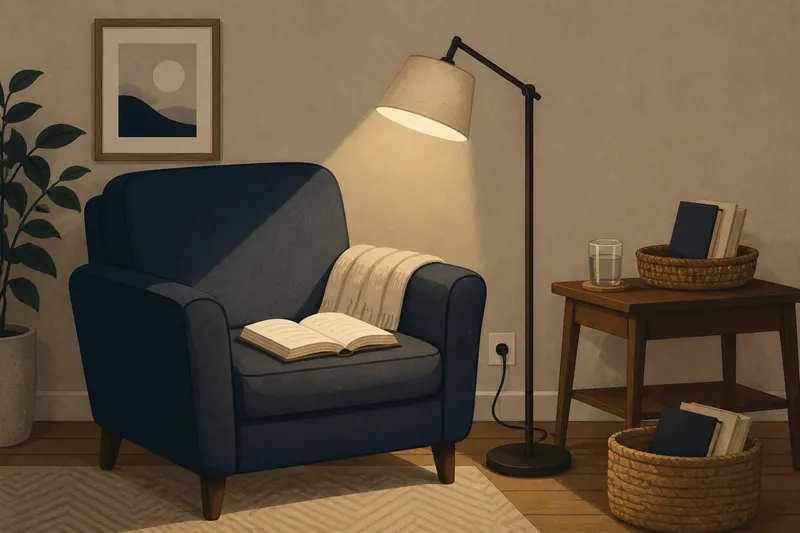
Say you have a hypothetical living room with a deep blue armchair, a narrow wooden table, a book basket and an outlet behind the chair. The current ceiling light leaves the reader’s hands in shadow. You have not bought a lamp yet, and the chair is used for reading as well as evening conversation.
First, sit in the chair with a book and notice where the page rests. In this invented situation, the reader holds it low, close to the lap. A light positioned high and directly overhead could leave the hands casting shadows across the page. A lamp placed to one side, with a head that can turn toward the book, is a more promising direction.
Next, check the narrow table. Its surface already holds a drink and the book basket would occupy the remaining space. A table lamp would crowd the reading spot, so the reader considers a floor lamp with a compact base that can sit beside the chair without interfering with the table. The outlet’s position also matters: a cord should not trail across the route into the chair.
Finally, compare the lamp’s appearance with the chair and table. A dark, heavy base might compete with the blue upholstery, while a slim stem and fabric shade could keep the corner visually open. The imagined result is a lamp that directs light toward the lap, leaves the table usable and gives the empty chair a recognizable outline after the reader leaves. The choice follows the room’s use rather than a showroom’s styling.
What should you ask before choosing a reading lamp?
Should a reading lamp be beside or behind the chair?
Place it where the beam reaches the page without shining into the reader’s eyes. The best side depends on the chair’s orientation, the reader’s usual position and whether the lamp head can be adjusted.
Is a floor lamp or a table lamp better for reading?
A table lamp suits a stable surface beside the reader, while a floor lamp can work when the table is small or already occupied. Compare the lamp’s base, reach and cord path with the actual space around the chair.
What kind of shade works for a reading lamp?
An opaque or partly opaque shade can help direct light downward and soften the view of the bulb. A more open shade spreads light farther, which may be useful when the lamp should also brighten the surrounding corner.
Does a reading lamp need an adjustable head?
Adjustability helps when the reader changes position or uses the chair for more than reading. A fixed shade can still work if its height and direction suit the usual reading posture.
How do you assess the lamp before it becomes part of the room?
Use the chair as your reference point, not a product photo. Check these details before settling on a design:
- Beam position: Sit as you normally would and identify where the page rests. Choose a lamp whose light can reach that spot without aiming at your face.
- Reading posture: Notice whether you lean back, turn sideways or move often. Favor a shade or head that suits the position you actually use.
- Surface space: Look at what already sits on the side table. If a lamp would displace the book, drink or glasses, consider a floor model instead.
- Visual weight: Compare the lamp’s base and shade with the chair and nearby furniture. A large shade can balance a broad chair; a delicate stem may suit a tighter corner.
- Room light: Ask whether the lamp should illuminate only the page or also soften the corner. The shade and bulb arrangement affect how far light spreads.
- Cord route: Trace where the cord would run to the outlet. Keep it out of the way of feet and the chair’s moving parts.
- Switched-off appearance: Look at the lamp from the room’s main doorway. Its outline should feel intentional even when it is not in use.
When comparing bulbs, shades or dimming features, follow the lamp maker’s instructions and the relevant product labels. The lamp’s appearance and light output depend on the components designed for that fitting.
When does a reading lamp belong in the room’s design?
A reading lamp belongs when its practical position and visual presence support each other. It should be easy to use from the chair, but it need not disappear when the book is put away. A shade that echoes another fabric, or a finish that relates to a nearby object, can make the corner feel considered without making every item match.
For a reading lamp, the order of decisions matters: locate the page, find a workable beam, account for the table and cord, then judge the lamp’s shape in the room. That sequence keeps the object connected to a human habit. A light chosen this way can serve the reader and give the room a distinct, useful point of focus.